
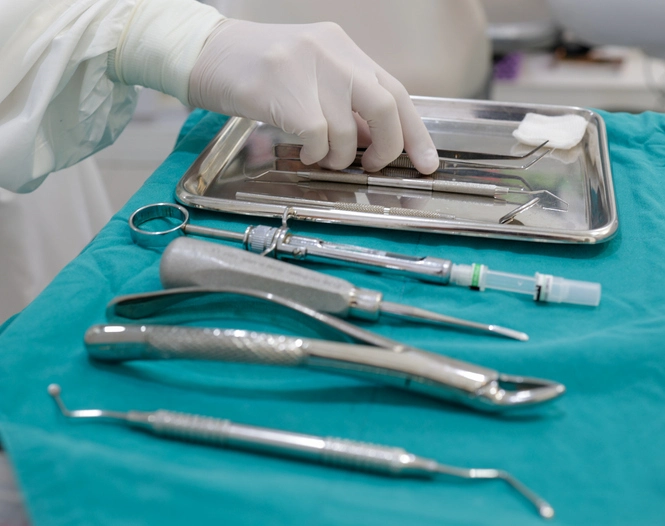
Oral surgery relies heavily on the correct selection and skilled use of surgical instruments. While clinical judgment and anatomical knowledge are fundamental, the effectiveness, safety, and efficiency of oral surgical procedures are closely linked to the operator’s familiarity with instruments. Each tool is designed with a specific purpose, and improper use can lead to complications such as unnecessary trauma, prolonged healing, patient discomfort, or surgical failure.
Table of Contents
ToggleExtraction Forceps
Purpose and Function
Extraction forceps are designed to deliver controlled forces to teeth in order to expand the alveolar socket and facilitate tooth removal. Their primary function is to grip the tooth securely at the cervical region while applying movements that loosen the periodontal ligament and expand surrounding bone.
Design and Variations
Extraction forceps come in a wide variety of shapes and sizes to accommodate differences in tooth anatomy, position, and root morphology. The beaks of the forceps are anatomically contoured to fit specific teeth, while the handles are designed to provide leverage and tactile feedback.
The choice of forceps depends on:
- Tooth type (incisor, premolar, molar)
- Maxillary or mandibular location
- Root form and divergence
- Access and mouth opening
- Operator preference and availability
Universal Forceps
Universal forceps are straight-bladed instruments designed for use on a range of teeth rather than a single specific tooth. They are available in maxillary and mandibular versions. Their versatility makes them particularly useful in general practice and emergency settings.
These forceps are mainly used to grip the root surface after crown fracture or when a precise tooth-specific forceps is unavailable. However, they may not provide the same degree of adaptation and control as dedicated forceps.
Eagle Beak Forceps
Eagle beak forceps are specifically designed for molar teeth. Their sharply pointed beaks engage the bifurcation of molar roots, allowing the application of buccally directed forces. This design is particularly advantageous when removing molars with intact bifurcations, as it enables controlled expansion of the socket.
Cowhorn Forceps
Cowhorn forceps are specialized molar forceps with pointed beaks that penetrate the furcation between molar roots. They can be used in a figure-of-eight motion to gradually loosen the tooth or to split the roots during extraction.
These forceps are especially effective in mandibular molars with well-defined bifurcations but must be used carefully to avoid excessive force that could fracture surrounding bone.
Deciduous Tooth Equivalents
Most extraction forceps have smaller counterparts designed for primary (deciduous) teeth. These are essential in pediatric dentistry, where root resorption and anatomical differences require appropriately sized instruments to minimize trauma.
Elevators
Purpose and Principle
Elevators are used to luxate teeth, expand the alveolar socket, and remove roots or impacted teeth. Unlike forceps, elevators rely on principles of leverage, wedge action, or wheel-and-axle mechanics rather than gripping.
They are indispensable in oral surgery and should always be used when removing impacted teeth or retained roots.
Proper Use
Elevators must be used with gentle, controlled finger pressure, not excessive force. Improper use can result in:
- Fracture of adjacent teeth
- Damage to alveolar bone
- Slippage causing soft tissue injury
The non-dominant hand should support the alveolus while the dominant hand applies controlled movements.
Common Types of Elevators
Coupland Elevators (Nos. 1, 2, and 3)
Coupland elevators are straight, narrow-bladed instruments used primarily for loosening teeth and expanding sockets. The different sizes allow selection based on the space available and the degree of force required.
Cryer Elevators (Right and Left)
Cryer elevators are triangular in shape and are designed for use in root removal, particularly after crown fracture. Their right- and left-handed versions correspond to the direction of root curvature or socket anatomy.
They are especially useful in mandibular molar extractions when one root has been removed and the remaining root can be elevated using the interradicular bone as a fulcrum.
Warwick-James Elevators
These elevators come in right, left, and straight forms and are commonly used for impacted teeth and root removal. Their curved blades allow access to difficult areas, particularly in posterior regions.
Luxators
Design and Purpose
Luxators resemble elevators but have a sharper and thinner blade with less concavity. Their primary purpose is not to lever teeth out, but to cut Sharpey’s fibers within the periodontal ligament.
Clinical Use
Luxators are inserted apically along the root surface and advanced slowly to sever periodontal fibers, thereby loosening the tooth. They are particularly useful in:
- Atraumatic extractions
- Preservation of alveolar bone
- Pre-implant extractions
Precautions
Because luxators are sharp and delicate, excessive force can lead to blade fracture or injury. They should be used with caution and never twisted forcefully.
Scalpel
Standard Choice
The most commonly used scalpel in oral surgery is a Bard-Parker handle fitted with a No. 15 blade.
Indications
Scalpels are used for:
- Incisions in mucosa
- Raising mucoperiosteal flaps
- Excision of soft tissue lesions
Technique
Incisions should be clean, decisive, and placed to allow adequate access while preserving blood supply. A dull blade should always be replaced, as it increases tissue trauma and impairs healing.
Periosteal Elevators
Purpose
Periosteal elevators are used to raise mucoperiosteal flaps from underlying bone, allowing access for surgical procedures.
Common Types
Howarth’s Elevator
Originally designed as a nasal raspatory, the Howarth’s elevator is widely favored in oral surgery due to its robust design and effective blade shape.
McDonald’s and No. 9 Elevators
These are alternative designs used depending on surgeon preference and specific surgical needs.
Technique
The sharp end is used to initiate flap elevation, while the broader end reflects the periosteum cleanly from bone, minimizing tearing.
Retractors
Purpose
Retractors are essential for maintaining visibility and protecting soft tissues during oral surgical procedures.
Commonly Used Retractors
- Dyson’s Tongue Retractor – stabilizes and retracts the tongue
- Kilner’s Cheek Retractor – retracts cheek tissues
- Bowdler-Henry Rake Retractor – useful for flap retraction
- Minnesota Flap Retractor – widely used for soft tissue and flap retraction
- Lacks Retractor – a versatile, all-purpose instrument
Clinical Importance
Proper retraction reduces tissue trauma, improves access, and enhances patient safety.
Chisels Versus Burs
Choice of Instrument
The decision to use chisels or burs depends largely on training, experience, and clinical setting.
Burs
Burs are generally preferred for conscious patients due to reduced discomfort and better control.
Commonly used burs include:
- No. 8 round bur – bone removal
- Medium taper fissure bur (T-C) – tooth sectioning
Chisels
Chisels are more commonly used in operating theatres under general anesthesia. T-tipped chisels (3 mm and 5 mm) are particularly useful for:
- Disto-angular third molars
- Upper third molars
Curettes
Purpose
Curettes are used for debridement of sockets, removal of granulation tissue, and smoothing bone edges.
Mitchell Trimmer
The Mitchell trimmer is widely regarded as the most valuable curette due to its versatility and effectiveness in post-extraction socket management.
Needle Holders and Sutures
Needle Holders
Needle holders vary in design depending on operator preference and surgical setting. They are used to securely grasp suture needles during wound closure.
Sutures
Suture Size
For intraoral (IO) work, 4/0 sutures are commonly used.
Suture Materials
- Non-absorbable: Silk
- Absorbable: Dexon®, Vicryl®
Absorbable sutures are now preferred for routine intraoral use, as they eliminate the need for suture removal and reduce patient discomfort.
Scissors
Types
- Dissecting scissors (e.g., McIndoe’s)
- Suture-cutting scissors
Key Principle
These should always be kept separate to prevent dulling of dissecting scissors, and both should be maintained in a sharp condition.
Dissecting Forceps
Purpose
Dissecting forceps are designed to hold soft tissue gently without causing damage.
Examples
Gillies dissecting forceps are commonly used. College tweezers, while often confused with dissecting forceps, are not designed for tissue handling and are mainly used to lift sutures prior to removal.
Aspirator
Function
The aspirator provides suction to maintain a clear surgical field.
Design
It uses a sterile or disposable suction tip small enough to access confined surgical sites and extraction sockets.
Importance
Effective suction improves visibility, reduces contamination, and enhances surgical precision.
Conclusion
Mastery of oral surgical instruments is a fundamental requirement for safe and effective practice. Understanding not only what each instrument does, but why and how it should be used, allows clinicians to minimize trauma, reduce complications, and improve patient outcomes. As experience grows, instrument selection becomes intuitive; however, this intuition must always be grounded in sound anatomical knowledge and respect for surgical principles.
A systematic, gentle, and informed approach to instrument use is the cornerstone of successful oral surgery.
References
- Peterson, L. J., Ellis, E., Hupp, J. R., & Tucker, M. R.
Contemporary Oral and Maxillofacial Surgery.
7th ed. St. Louis: Elsevier; 2019. - Hupp, J. R., Ellis, E., & Tucker, M. R.
Principles of Oral and Maxillofacial Surgery.
6th ed. St. Louis: Elsevier; 2014. - Howe, G. L.
Minor Oral Surgery.
4th ed. London: Wright; 2004. - McGregor, A. D., & MacDonald, D. G.
A Colour Handbook of Oral and Maxillofacial Surgery.
2nd ed. London: Wolfe Medical Publications; 1993. - Malamed, S. F.
Medical Emergencies in the Dental Office.
7th ed. St. Louis: Elsevier; 2014. - Scully, C., & Felix, D. H.
Oral and Maxillofacial Medicine: The Basis of Diagnosis and Treatment.
3rd ed. London: Churchill Livingstone; 2013. - Bennett, J. D., & Rosenberg, P. A.
Clinical Manual of Oral and Maxillofacial Surgery.
Chicago: Quintessence Publishing; 2000. - British Association of Oral and Maxillofacial Surgeons (BAOMS).
Guidelines for Dentoalveolar Surgery.
London: BAOMS; latest edition. - Ten Cate, A. R.
Oral Histology: Development, Structure, and Function.
8th ed. St. Louis: Elsevier; 2013. - Whaites, E., & Drage, N.
Essentials of Dental Radiography and Radiology.
5th ed. London: Churchill Livingstone; 2013.