
Root canal treatment (RCT), or endodontic therapy, aims to eliminate infection, prevent reinfection, and preserve the natural tooth. Success in this procedure relies not only on the clinician’s technique but also heavily on the selection and correct application of various materials. Each material—from irrigants to sealers—plays a unique and essential role in ensuring the long-term biological and functional success of endodontic therapy.
Table of Contents
ToggleIrrigants in Root Canal Therapy
Mechanical instrumentation alone is insufficient to thoroughly clean and disinfect the complex anatomy of the root canal system. Irrigants complement instrumentation by flushing debris, dissolving necrotic tissues, killing microbes, and lubricating instruments.
Sodium Hypochlorite (NaOCl)
Dilute sodium hypochlorite is universally regarded as the gold-standard irrigant. Typically used in concentrations around 2.5% available chlorine, NaOCl exhibits strong bactericidal, virucidal, and fungicidal activity. Its unique capacity to dissolve organic tissue—including necrotic pulp, bacterial biofilms, and organic debris—makes it indispensable.
In addition to its antimicrobial properties, NaOCl’s saponifying action helps reduce dentine debris and facilitates smoother instrumentation.
Despite its advantages, sodium hypochlorite has limitations. It is cytotoxic when extruded beyond the apex and can irritate periapical tissues. Therefore, proper irrigation technique, including controlled delivery and negative pressure systems, is essential.
Chelating Agents: EDTA and Citric Acid
Chelating agents such as ethylenediaminetetraacetic acid (EDTA) paste, File-Eze®, and RC Prep™ remove the inorganic component of the smear layer formed during instrumentation. The smear layer, composed of dentine particles and microorganisms, can obstruct disinfectants from penetrating dentinal tubules. EDTA’s demineralizing action softens dentine, making it valuable for negotiating calcified, sclerosed, or narrow canals.
Citric acid functions similarly and is sometimes preferred for its natural origin and biocompatibility profile. Alternating NaOCl with a chelating agent optimizes cleaning by removing both organic and inorganic debris.
Optimization of Irrigation
Current endodontic protocols emphasize agitation or activation of irrigants. Methods such as sonic, ultrasonic, or mechanical activation allow irrigants to reach inaccessible areas such as lateral canals, fins, and isthmuses. This significantly enhances their antimicrobial and tissue-dissolving capacity.
Canal Medication
Inter-appointment medicaments are used primarily in cases involving persistent infection, exudation, or symptoms. Their aim is to further disinfect the canal system and reduce inflammation between visits.
Calcium Hydroxide Pastes (Hypocal™, Ultracal®)
Non-setting calcium hydroxide paste is the most widely used inter-appointment medicament due to its high pH (around 12.5), which creates an environment hostile to most microorganisms. Calcium hydroxide:
- Denatures bacterial proteins
- Inactivates lipopolysaccharides (LPS)
- Neutralizes acids
- Supports hard tissue formation
It is particularly effective in canals with persistent inflammatory exudate and is considered a hallmark material in multi-visit endodontic therapy.
However, calcium hydroxide does not effectively eliminate certain resistant species such as Enterococcus faecalis or Candida albicans, which has led to exploration of alternative medicaments.
Antibiotic/Steroid Pastes (Odontopaste®)
Pain and inflammation management is crucial during endodontic treatment. Odontopaste® combines three key components:
- Calcium hydroxide
- Clindamycin hydrochloride, a broad-spectrum antibiotic effective against anaerobes
- Triamcinolone acetonide, a potent corticosteroid providing anti-inflammatory effects
This combination is particularly beneficial when anaesthesia is difficult due to a hyperaemic or inflamed pulp. By reducing inflammation, Odontopaste® increases the likelihood of achieving profound anaesthesia at the next appointment.
While effective for decreasing bacterial load and symptom control, its use should be judicious to avoid contributing to antibiotic resistance. Therefore, Odontopaste® is generally reserved for specific clinical situations rather than routine use.
Iodine-Containing Pastes (Vitapex®, Calcipast-I’se)
These materials are especially helpful in retreatment scenarios. Some microorganisms commonly found in previously treated canals (such as certain Gram-positive bacteria and fungi) are resistant to calcium hydroxide. Iodine-based pastes exhibit broad-spectrum antimicrobial activity and can penetrate complex canal anatomy.
Vitapex®, a combination of calcium hydroxide, iodoform, and silicone oil, is also commonly used in paediatric pulpectomies due to its resorbability and biocompatibility.
Root Canal Filling Materials (Obturation Materials)
After cleaning and shaping, the root canal system must be filled in three dimensions to prevent reinfection. The ideal filling material should:
- Seal the canal system tightly
- Be biocompatible
- Be dimensionally stable
- Be easy to manipulate and remove if necessary
Gutta-Percha (GP)
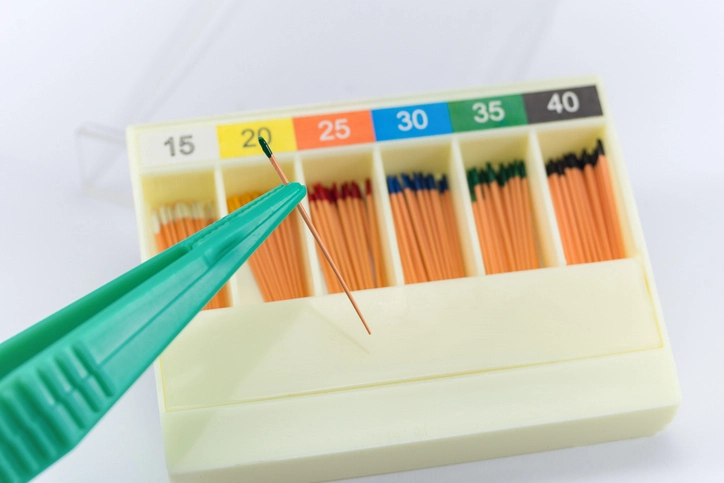
Gutta-percha, derived from natural latex, remains the material of choice for root canal obturation. It is supplied in solid cones matched to standardized instrument sizes.
Two main types of cones are used:
- Master cones – sized to the master apical file
- Accessory cones – used with finger spreaders during lateral condensation
Some obturation systems, particularly those associated with rotary instrumentation, recommend single-cone techniques. Although simpler and faster, single cones result in a higher proportion of sealer in the canal, which can affect long-term stability since sealer may dissolve or shrink with time.
Gutta-percha itself is inert and requires the use of a sealer to bond it to dentine.
Sealers
Sealers fill the microscopic gaps between gutta-percha and canal walls, ensuring a hermetic seal. Several categories of sealers are available:
Calcium Hydroxide Sealers (e.g., Sealapex™)
These sealers are known for:
- High biocompatibility
- Antibacterial properties due to calcium hydroxide release
- Encouraging hard tissue deposition
However, they may undergo slight solubility over time.
Eugenol-Based Sealers (e.g., Tubiseal™)
Zinc oxide–eugenol sealers have been used for decades. Their advantages include:
- Antimicrobial properties
- Good flow
- Long working time
Yet, they may cause irritation in sensitive patients, and eugenol can interfere with resin bonding procedures if not completely removed.
Resin-Based Sealers (e.g., AH Plus®)
These are highly popular due to:
- Excellent sealing ability
- Low solubility
- Good radiopacity
- High dimensional stability
AH Plus® has become the benchmark among resin sealers.
Glass Ionomer (GI)–Based Sealers (e.g., Ketac™ Endo)
GI sealers bond to dentine chemically and release fluoride. Nonetheless, they are less commonly used today due to brittleness and technique sensitivity.
Calcium Silicate–Based Sealers (e.g., BioRoot™ RCS, TotalFill™)
These modern bioceramic sealers offer significant advantages:
- Outstanding biocompatibility
- Hydroxyapatite formation
- Moisture tolerance
- Antibacterial alkaline pH
They also complement single-cone obturation techniques, as they bond chemically with dentine and gutta-percha.
Calcium Hydroxide: Additional Applications
Beyond its use as a medicament and sealer component, calcium hydroxide has other important roles in endodontics.
Antibacterial and Proteolytic Properties
Its high alkalinity damages bacterial membranes, denatures proteins, and dissolves necrotic tissue. The ability to inactivate endotoxins is particularly valuable in treating infected canals.
Promotion of Hard Tissue Formation
Calcium hydroxide stimulates mineralization and dentine bridge formation, making it useful in pulp capping and apexification (forming a calcific barrier at the root end). However, it has largely been replaced by MTA and newer bioceramics in these applications.
Application Techniques
The material may be delivered using:
- Lentulo spiral fillers – which reduce the risk of extrusion
- Cannula-based systems – allowing precise placement
Mineral Trioxide Aggregate (MTA)
MTA revolutionized endodontics upon its introduction as a biocompatible, moisture-tolerant material capable of forming a durable physical barrier. Composed primarily of calcium silicate, MTA resembles Portland cement with added radiopacifiers.
Key Properties
- Biocompatibility: MTA is well tolerated by tissues and stimulates healing.
- Hydrophilic setting reaction: It requires moisture to set, making it ideal for clinical environments where dryness is difficult.
- Calcium hydroxide release: This supports hard tissue formation and antimicrobial action.
- Excellent sealing ability: MTA expands slightly upon setting, enhancing its sealing capacity.
Clinical Applications
MTA is widely used for:
- Apexification
- Apical barriers in immature teeth
- Perforation repair
- Root-end fillings in apicoectomy
- Pulp capping and pulpotomy
Limitations
Despite its benefits, MTA is:
- Difficult to handle due to its sandy consistency
- Slow to set (initial set often >2 hours)
- Expensive
- Associated with grey discoloration (attributed to bismuth oxide used as a radiopacifier)
Discoloration has led to the development of white MTA and alternative bioceramics such as Biodentine®, MTA Angelus®, and others, which aim to maintain biocompatibility while improving handling and aesthetics.
Conclusion
Root canal treatment relies on a diverse array of materials, each engineered to meet a specific biological or mechanical demand. Irrigants such as sodium hypochlorite and EDTA provide chemical cleansing and disinfection, while medicaments like calcium hydroxide and Odontopaste® offer inter-appointment infection control. Obturation materials—including gutta-percha and various sealers—ensure long-term sealing of the cleaned canal system. Modern bioceramics such as MTA and Biodentine® represent significant advancements in biocompatibility and regenerative potential.
A clinician’s understanding of these materials, their properties, and their appropriate applications is essential for achieving predictable, successful endodontic outcomes. As research advances, endodontic materials continue to improve in safety, biological compatibility, sealing ability, and ease of use, ultimately contributing to better patient care and long-term tooth preservation.
References
- Hargreaves, K. M., Berman, L. H. (Eds.). Cohen’s Pathways of the Pulp. 11th ed. St. Louis: Mosby Elsevier; 2016.
- Torabinejad, M., Walton, R. E. Endodontics: Principles and Practice. 5th ed. Philadelphia: Saunders Elsevier; 2015.
- Pitt Ford, T. R., Rhodes, J. S. Pitt Ford’s Problem-Based Learning in Endodontology. Churchill Livingstone; 2006.
- Ingle, J. I., Bakland, L. K., Baumgartner, J. C. Ingle’s Endodontics. 7th ed. Hamilton: BC Decker; 2019.
- Zehnder, M. “Root canal irrigants.” Journal of Endodontics. 2006;32(5):389–398.
- Haapasalo, M., Endal, U., Zandi, H., Coil, J. “Eradication of endodontic infection by instrumentation and irrigation solutions.” Endodontic Topics. 2005;10(1):77–102.
- Siqueira, J. F., Rôças, I. N. “Clinical implications and microbiology of bacterial persistence after treatment procedures.” Journal of Endodontics. 2008;34(11):1291–1301.
- Mohammadi, Z., Dummer, P. M. H. “Properties and applications of calcium hydroxide in endodontics and dental traumatology.” International Endodontic Journal. 2011;44(8):697–730.
- Torabinejad, M., Parirokh, M. “Mineral trioxide aggregate: A comprehensive literature review—Part I & II.” Journal of Endodontics. 2010;36(1):16–27, 190–202.
- Grossman, L. I. “Physical properties of root canal cements.” Journal of Endodontics. 1976;2(6):166–175.
- Donovan, T. E., Cho, G. C. “Contemporary obturation materials and techniques.” Journal of the California Dental Association. 2016;44(9):553–560.
- Camps, J., Jeanneau, C., El Ayachi, I., Laurent, P., About, I. “Bioactivity of calcium silicate-based sealers.” Journal of Endodontics. 2015;41(9):139–143.
- Dentsply Sirona. AH Plus Root Canal Sealer – Technical Data Sheet.
- Septodont. Biodentine: Scientific File.
- Angelus Dental. MTA Angelus: Instructions for Use.
- Spångberg, L. “Biological effects of root canal filling materials.” Oral Surgery, Oral Medicine, Oral Pathology. 1969;28(6):923–936.
- McComb, D., Smith, D. C. “A preliminary scanning electron microscopic study of root canals after endodontic procedures.” Journal of Endodontics. 1975;1(7):238–242.