
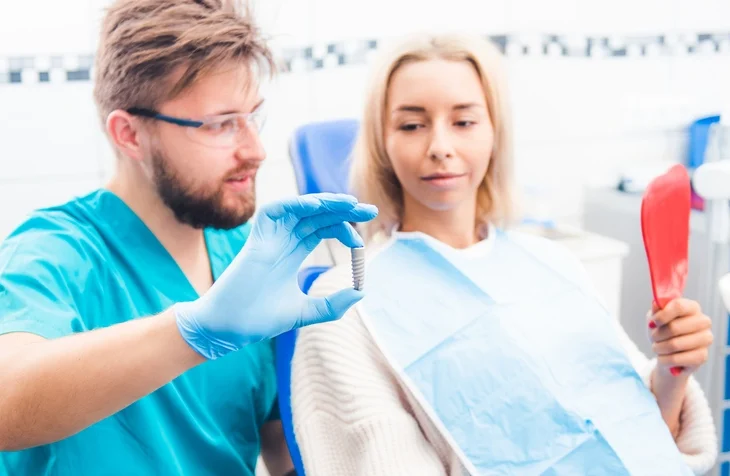
Dental implants have become a cornerstone of modern restorative dentistry, offering predictable and long-lasting solutions for the replacement of missing teeth. Advances in implant materials, surface technologies, surgical protocols, and prosthetic design have resulted in high survival and success rates. However, implant therapy does not end at placement or prosthetic restoration. Long-term success depends heavily on appropriate follow-up, maintenance, patient compliance, and early detection of complications.
Table of Contents
ToggleImportance of Follow-Up and Maintenance in Implant Dentistry
If dental implants survive the first two years after placement, studies show a success rate of approximately 98%, with significant improvements in functional outcomes such as mastication, speech, and patient comfort. The first two years are therefore considered a critical period, as failures during this time are more likely to be related to surgical or biological factors.
Long-term implant success relies on a shared responsibility between the clinician and the patient:
- The clinician must monitor the implant clinically and radiographically.
- The patient must maintain excellent oral hygiene and attend regular recall visits.
Implant-retained restorations, unlike natural teeth, lack a periodontal ligament. This alters proprioception and reduces the patient’s ability to detect excessive occlusal forces, increasing the importance of professional monitoring.
Mandibular vs Maxillary Implant Success
Success rates of implants placed in the mandible are consistently higher than those in the maxilla. This difference is primarily attributed to:
Bone quality:
Mandible: Dense cortical bone (Type I or II)
Maxilla: Less dense trabecular bone (Type III or IV)
Improved primary stability in mandibular bone
Reduced micromovement during healing
Because of these anatomical differences, implant planning in the maxilla often requires additional procedures such as sinus augmentation or bone grafting.
Long-Term Clinical and Radiographic Monitoring
Dental implants require lifelong follow-up. Monitoring includes:
Clinical Examination
- Assessment of implant mobility
- Evaluation of peri-implant soft tissues
- Probing depths around the implant
- Presence of bleeding on probing or suppuration
- Occlusal analysis
Radiographic Examination
- Baseline radiographs after restoration
- Periodic radiographs to monitor crestal bone levels
- Identification of peri-implant radiolucency
Radiographs help differentiate between physiological bone remodeling and pathological bone loss.
Implant Failure: Early and Late Failure
Implant failure is broadly categorized into early failure and late failure, depending on the timing and underlying cause.
Early Implant Failure
Early failure occurs before or shortly after osseointegration, typically within the first few months. Common causes include:
- Inadequate site preparation
- Overheating of bone during drilling
- Infection at the surgical site
- Premature loading of the implant
- Lack of primary (1°) stability
Excessive heat generation (>47°C) during osteotomy preparation can cause bone necrosis, preventing osseointegration. Similarly, micromovement exceeding 100–150 µm during healing can disrupt the bone-implant interface.
Late Implant Failure
Late failure occurs after successful osseointegration, often years after implant placement. Common causes include:
- Occlusal overloading
- Prosthetic complications
- Peri-implant infection (peri-implantitis)
Late failure emphasizes the importance of long-term maintenance and occlusal control.
Maintenance Challenges of Implant Restorations
Literature consistently highlights that maintenance of implant restorations is an ongoing challenge. Mechanical complications may include:
- Loosening or fracture of screws
- Fracture of porcelain or acrylic
- Wear of attachment systems (e.g. clips, bars, locator attachments)
These complications do not necessarily indicate implant failure but require ongoing professional management.
Defining Implant Success
Implant success should not be confused with implant survival. While survival simply means the implant remains in situ, success is a more comprehensive concept.
Reported Success Rates
Long-term studies report implant success rates exceeding 90% after 10 years, highlighting the predictability of modern implant therapy when appropriate protocols are followed.
Criteria for Implant Failure
An implant can be considered to have failed if there is:
- Failure of osseointegration
- Failure to maintain osseointegration
Both scenarios ultimately compromise the function and prognosis of the implant.
Criteria for Implant Success
A dental implant is considered successful if it:
- Is present and functional
- Allows acceptable mastication and phonation
- Is pain-free
- Exhibits no clinical mobility
- Shows no peri-implant radiolucency
- Demonstrates bone loss of less than 1.5 mm
Neurological complications such as paraesthesia should not be present, although they remain a recognized risk of implant surgery, particularly in the posterior mandible.
Aesthetic Success in Implant Dentistry
Beyond function, aesthetics play a critical role in patient satisfaction, especially in the anterior region.
Aesthetic Evaluation Tools
Aesthetic outcomes are commonly assessed using:
- Pink Aesthetic Score (PES) – evaluates peri-implant soft tissue
- White Aesthetic Score (WES) – evaluates the implant crown
These scoring systems assess factors such as gingival contour, papillae, color, texture, crown shape, and shade.
Peri-Implant Diseases
Peri-Implant Mucositis
Peri-implant mucositis is defined as a reversible inflammatory condition affecting the soft tissues surrounding an implant without bone loss. It is analogous to gingivitis around natural teeth.
Clinical features include:
- Redness
- Swelling
- Bleeding on probing
Importantly, peri-implant mucositis is fully reversible if identified early and managed appropriately.
Peri-Implantitis
Peri-implantitis is a more severe condition involving destructive inflammation of both soft and hard tissues surrounding a previously osseointegrated implant. It is analogous to periodontitis around natural teeth.
Clinical features include:
- Bleeding on probing
- Suppuration
- Increased probing depths
- Progressive peri-implant bone loss
- Possible implant mobility in advanced cases
Prevalence of Peri-Implantitis
Despite high implant survival rates (>90% at 10 years), studies suggest that over 40% of patients may experience peri-implantitis to some degree. This highlights the discrepancy between survival and true biological success.
The pathogenesis of peri-implantitis is not yet fully understood but is considered multifactorial.
Risk Factors for Peri-Implantitis
Several patient-related, prosthetic, and surgical factors increase the risk of peri-implant disease:
Oral Hygiene
- Inadequate oral hygiene is a major risk factor
- Plaque accumulation leads to inflammatory changes
Prosthetic Design
- Overcontoured restorations
- Poor emergence profiles
- Designs that hinder effective cleaning
Occlusal Factors
- Excessive occlusal loading
- Parafunctional habits such as bruxism
Systemic Factors
- Poorly controlled diabetes
- Smoking
Periodontal History
Existing or previous periodontal disease (treated or untreated)
Surgical and Anatomical Factors
- Thin bone coverage at implant placement
- Thin gingival biotype
- Reduced soft tissue thickness
Iatrogenic Factors
Residual cement from cement-retained restorations
Diagnosis of Peri-Implant Disease
Diagnosis involves a combination of clinical and radiographic assessment:
- Radiographic evaluation for bone loss
- Assessment of gingival color and texture
- Bleeding on probing
- Presence of suppuration
- Increased probing depths
Baseline records are essential to detect disease progression accurately.
Management of Peri-Implant Disease
Management depends on disease severity and may include:
Non-Surgical Management
- Local debridement
- Improved oral hygiene instruction
- Antimicrobial therapy (adjunctive)
Surgical Management
- Open-flap debridement
- Bone grafting
- Regenerative procedures
Early intervention improves prognosis and may prevent implant loss.
Craniofacial Implants
Craniofacial implants extend the principles of oral implantology beyond dentistry. They are used to retain prosthetic:
- Eyes
- Ears
- Noses
These implants are anchored to the facial skeleton and utilize techniques similar to oral implant placement. Craniofacial implants significantly improve aesthetics, function, and quality of life for patients with congenital defects, trauma, or oncological resections.
Conclusion
Dental implants are a highly predictable and successful treatment modality, but their long-term success depends on meticulous planning, execution, and maintenance. While survival rates are high, true success requires biological stability, functional efficiency, and aesthetic harmony.
Peri-implant diseases remain a significant challenge, emphasizing the importance of patient education, regular follow-up, and early intervention. Understanding risk factors and diagnostic principles allows clinicians to prevent complications and manage them effectively when they arise.
Ultimately, implant dentistry is not a single procedure but a lifelong commitment to patient care.
References
- Adell R, Lekholm U, Rockler B, Brånemark PI.
A 15-year study of osseointegrated implants in the treatment of the edentulous jaw.
International Journal of Oral Surgery. 1981;10(6):387–416. - Adell R.
Clinical results of osseointegrated implants supporting fixed prostheses in edentulous jaws.
Journal of Prosthetic Dentistry. 1983;49(2):251–257. - Albrektsson T, Zarb G, Worthington P, Eriksson AR.
The long-term efficacy of currently used dental implants: a review and proposed criteria of success.
International Journal of Oral & Maxillofacial Implants. 1986;1(1):11–25. - Brånemark PI, Zarb GA, Albrektsson T.
Tissue-Integrated Prostheses: Osseointegration in Clinical Dentistry.
Chicago: Quintessence Publishing; 1985. - Esposito M, Hirsch JM, Lekholm U, Thomsen P.
Biological factors contributing to failures of osseointegrated oral implants (I & II).
European Journal of Oral Sciences. 1998;106(1):527–551. - Dreyer H, Grischke J, Tiede C, et al.
Epidemiology and risk factors of peri-implantitis: A systematic review.
Journal of Periodontal Research. 2018;53(Suppl 1):S657–S672. - Berglundh T, Persson L, Klinge B.
A systematic review of the incidence of biological and technical complications in implant dentistry.
Journal of Clinical Periodontology. 2002;29(Suppl 3):197–212. - Lang NP, Berglundh T; Working Group 4 of the Seventh European Workshop on Periodontology.
Periimplant diseases: where are we now?
Journal of Clinical Periodontology. 2011;38(Suppl 11):178–181. - Heitz-Mayfield LJA, Mombelli A.
The therapy of peri-implantitis: a systematic review.
International Journal of Oral & Maxillofacial Implants. 2014;29(Suppl):325–345. - Lindhe J, Meyle J; Group D of the European Workshop on Periodontology.
Peri-implant diseases: Consensus report of the Sixth European Workshop on Periodontology.
Journal of Clinical Periodontology. 2008;35(Suppl 8):282–285. - Sanz M, Chapple IL; Working Group 4 of the VIII European Workshop on Periodontology.
Clinical research on peri-implant diseases: consensus report.
Journal of Clinical Periodontology. 2012;39(Suppl 12):202–206. - Derks J, Tomasi C.
Peri-implant health and disease. A systematic review of current epidemiology.
Journal of Clinical Periodontology. 2015;42(Suppl 16):S158–S171. - Pjetursson BE, Asgeirsson AG, Zwahlen M, Sailer I.
Improvements in implant dentistry over the last decade: a systematic review.
Clinical Oral Implants Research. 2014;25(Suppl 2):1–20. - Belser UC, Grütter L, Vailati F, Bornstein MM, Weber HP, Buser D.
Outcome evaluation of early placed maxillary anterior single-tooth implants using objective aesthetic criteria.
Journal of Periodontology. 2009;80(1):140–151. - Buser D, Martin W, Belser UC.
Optimizing esthetics for implant restorations in the anterior maxilla: anatomic and surgical considerations.
International Journal of Oral & Maxillofacial Implants. 2004;19(Suppl):43–61.