
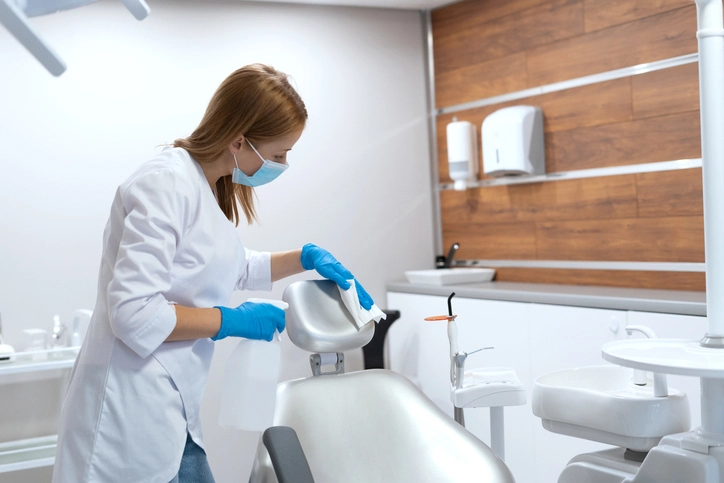
Oral surgery is an invasive discipline within dentistry that inevitably exposes both patients and healthcare professionals to microorganisms. The oral cavity harbors one of the most complex microbial ecosystems in the human body, containing bacteria, viruses, fungi, and protozoa. Many of these organisms are harmless commensals; however, under surgical conditions they may become pathogenic, leading to local or systemic infection. Furthermore, blood-borne pathogens such as hepatitis viruses and HIV pose occupational risks to clinicians.
To mitigate these risks, strict principles of asepsis, antisepsis, disinfection, and cross-infection control are fundamental to safe practice. These principles form the cornerstone of modern oral surgery and are not optional adjuncts but essential professional responsibilities.
Table of Contents
ToggleAsepsis
Definition and Concept
Asepsis refers to the absence of pathogenic microorganisms. In practical terms, it is the deliberate effort to prevent the introduction of microorganisms into a surgical field. In dentistry, absolute sterility is impossible due to the nature of the oral environment; nevertheless, aseptic technique aims to reduce microbial contamination to the lowest achievable level.
The term “aseptic technique” describes a set of procedures used to prevent contamination of wounds, instruments, and operative sites. These techniques are well established in medical and dental surgery and form the basis of infection prevention strategies.
Aseptic Technique in Oral Surgery
In oral surgery, aseptic technique includes:
- Use of sterile instruments
- Wearing sterile gloves during surgical procedures
- Use of sterile drapes and clothing
- Adoption of a “no-touch technique”, where sterile instruments are used to handle surgical materials instead of hands
- Maintaining a clean operative field
Unlike other surgical specialties, oral surgery is performed in a contaminated environment. Saliva, plaque, and gingival crevicular fluid all contain microorganisms. Therefore, the goal is not to eliminate microbes entirely but to prevent additional contamination and reduce the microbial burden during surgery.
Limitations of Asepsis in Dentistry
It is important to acknowledge that the mouth cannot be rendered aseptic, regardless of preparation. Attempts to completely sterilize the oral cavity are futile and unnecessary. Instead, asepsis focuses on controlling what can reasonably be controlled—namely, instruments, operator behavior, and procedural discipline.
Antisepsis
Definition
Antisepsis refers to the use or application of chemical agents (antiseptics) that inhibit or destroy microorganisms on living tissues. Unlike disinfectants, which are used on inanimate objects, antiseptics are safe for use on skin and mucosa.
Common Antiseptic Practices in Oral Surgery
Examples of antisepsis in dentistry include:
- Surgical hand scrubbing
- Preparation of the operative site
- Use of antiseptic mouthrinses
- Skin disinfection prior to injections or incisions
One of the most commonly used antiseptics in dentistry is chlorhexidine, which has broad-spectrum antimicrobial activity and prolonged residual effect.
Role of Antisepsis in Infection Prevention
Antisepsis reduces the number of microorganisms at the surgical site and on the clinician’s hands, thereby lowering the risk of postoperative infection. While antiseptics do not sterilize tissues, they significantly reduce microbial load and interrupt transmission pathways.
Disinfection and Sterilization
Disinfection
Disinfection is the inhibition or destruction of pathogenic microorganisms on inanimate objects. It does not eliminate all forms of life, particularly bacterial spores.
Disinfection is commonly used for:
- Environmental surfaces
- Dental impressions
- Equipment that cannot withstand sterilization
Chemical agents such as hypochlorite and glutaraldehyde have historically been used for disinfection. However, their use is increasingly restricted due to toxicity, environmental concerns, and occupational hazards.
Sterilization
Sterilization refers to the complete destruction or removal of all forms of life, including bacteria, viruses, fungi, and spores. In dentistry, sterilization is considered the gold standard for instrument processing.
The most reliable method of sterilization is steam sterilization (autoclaving):
- 121°C for 15 minutes
- 134°C for 3 minutes
Pre-packaged sterile supplies and autoclaved reusable instruments are the only truly acceptable methods of ensuring sterility in dental practice.
Why Sterilization Is Essential
Failure to properly sterilize instruments can result in cross-infection between patients, transmission of blood-borne viruses, and serious medico-legal consequences. Disinfection alone is insufficient for critical instruments that penetrate tissue or contact blood.
Principles of Infection Prevention in Oral Surgery
Although the mouth cannot be sterilized, three core principles guide safe practice:
1. Avoid Introducing Infection
This is achieved by:
- Using sterilized instruments
- Ensuring packaging integrity
- Wearing gloves
- Avoiding contamination of sterile fields
The introduction of external pathogens into surgical wounds can significantly increase the risk of postoperative complications.
2. Avoid Being Infected by the Operative Site
Clinicians are at constant risk of exposure to saliva, blood, and aerosols. Protection is achieved by:
- Wearing gloves
- Using face masks
- Wearing protective eyewear or face shields
These barriers protect against splashes, aerosols, and direct contact with infectious material.
3. Reduce the Microbial Load at the Site
Microbial load can be reduced through:
- Pre-extraction tooth cleaning
- Use of chlorhexidine mouthrinse
- Judicious use of prophylactic antibiotics
Although evidence supporting some of these practices is limited, they are widely accepted as logical and beneficial adjuncts to infection control.
Cross-Infection and Its Control
Definition
Cross-infection refers to the transfer of infectious agents between patients and healthcare workers within a clinical environment.
Historical Context
Awareness of cross-infection in dentistry increased significantly with:
- Hepatitis B outbreaks
- Emergence of HIV/AIDS
- Concerns regarding prion diseases
Many infected individuals are asymptomatic, making screening unreliable as a sole preventive strategy. Therefore, modern dentistry adopts universal precautions, treating all patients as potentially infectious.
Universal Infection Control
Universal infection control requires consistent application of protective measures for every patient, regardless of perceived risk. This approach protects both patients and staff and removes stigma associated with known infections.
Aerosols and Their Risks
Dental procedures frequently generate aerosols through:
- High-speed handpieces
- Ultrasonic scalers
- Air-water syringes
Aerosols may contain saliva, blood, microorganisms, and debris, posing a risk of inhalation or mucosal contact.
Risk Reduction Strategies
- Use of high-volume suction
- Wearing masks and protective eyewear
- Minimizing aerosol-generating procedures when possible
Although masks have not conclusively been shown to prevent wound infection, they are effective in protecting clinicians from inhaling contaminated aerosols.
Cleaning and Sterilizing Equipment
Instrument Processing
Effective sterilization requires prior cleaning. Organic debris can shield microorganisms from heat and chemicals.
Key steps include:
- Cleaning instruments before sterilization
- Using ultrasonic cleaners or washer-disinfectors
- Sterilizing according to manufacturer guidelines
Use of Disposable Equipment
Disposable items should be used whenever feasible and never reused. Work surfaces should be either disposable or easily disinfected.
Environmental cleaning is often overlooked but is critical in reducing indirect transmission.
Glove Use in Oral Surgery
Gloves serve as a barrier between clinician and patient.
- Non-sterile gloves are appropriate for routine procedures
- Sterile gloves are required for surgical procedures
Gloves must be changed between patients and should never replace proper hand hygiene.
Immunization
Immunization against hepatitis B is a professional obligation for dental staff. It significantly reduces occupational risk and protects both clinicians and patients.
All staff with clinical contact should:
- Be vaccinated
- Have immunity confirmed where appropriate
Waste Disposal
Proper waste disposal is a shared responsibility.
Sharps Management
Sharps must be:
- Disposed of immediately after use
- Placed in rigid, labeled containers
- Handled according to local regulations
Improper sharps disposal is a major cause of occupational injury.
Needlestick Injuries
Immediate Management
If a needlestick injury occurs:
- Stop the procedure
- Ensure patient safety
- Rinse the wound under running water
- Record the incident and patient details
Follow-Up and Testing
The patient must be informed and appropriate testing arranged. National guidelines recommend testing for:
- Hepatitis B
- Hepatitis C
- HIV
Post-Exposure Prophylaxis
Post-exposure prophylaxis (PEP), including highly active antiretroviral therapy (HAART), has been shown to significantly reduce the risk of HIV seroconversion when administered promptly.
Conclusion
Asepsis, antisepsis, and infection control are fundamental to safe oral surgery. They protect patients from postoperative infection and safeguard healthcare professionals from occupational hazards. While the oral environment presents unique challenges, adherence to established principles—sterilization, protective barriers, universal precautions, and proper waste management—ensures that oral surgery can be practiced safely and ethically.
Infection control is not a static discipline but an evolving one. As new pathogens emerge and technologies advance, dental professionals must remain vigilant, informed, and committed to best practices. Ultimately, effective infection control reflects professionalism, responsibility, and respect for patient welfare.
References
- Cawson, R. A., Odell, E. W., & Porter, S.
Cawson’s Essentials of Oral Pathology and Oral Medicine.
8th ed. Churchill Livingstone Elsevier; 2008. - Peterson, L. J., Ellis, E., Hupp, J. R., & Tucker, M. R.
Contemporary Oral and Maxillofacial Surgery.
6th ed. Elsevier Mosby; 2014. - Scully, C., & Flint, S.
Oral and Maxillofacial Diseases.
4th ed. CRC Press; 2014. - World Health Organization (WHO).
Guidelines on Core Components of Infection Prevention and Control Programmes at the National and Acute Health Care Facility Level.
WHO Press; 2016. - Centers for Disease Control and Prevention (CDC).
Guidelines for Infection Control in Dental Health-Care Settings.
MMWR Recomm Rep. 2003;52(RR-17):1–61. - Department of Health (UK).
Health Technical Memorandum 01-05: Decontamination in Primary Care Dental Practices.
Department of Health; latest edition. - British Dental Association (BDA).
Infection Control in Dentistry: Advice Sheet.
BDA Publications; London. - Wilson, W. et al.
Prevention of infective endocarditis: Guidelines from the American Heart Association.
Circulation. 2007;116(15):1736–1754. - Syrjänen, S., & Laine, P.
Infection control in dentistry.
Oral Diseases. 2018;24(5):844–856. - Kohn, W. G., Harte, J. A., Malvitz, D. M., et al.
Guidelines for infection control in dental health-care settings—2003.
Journal of the American Dental Association. 2004;135(1):33–47. - Sridhar, S., & Cumberbatch, M.
Occupational exposure and needlestick injuries in dentistry.
British Dental Journal. 2017;223(5):321–325. - Hupp, J. R.
Principles of surgery and infection control.
In: Oral and Maxillofacial Surgery Foundations. Elsevier; 2019. - Palmer, N. O. A., & Martin, M. V.
An investigation of antibiotic prescribing by dentists in England.
British Dental Journal. 1998;185(11):554–558.