
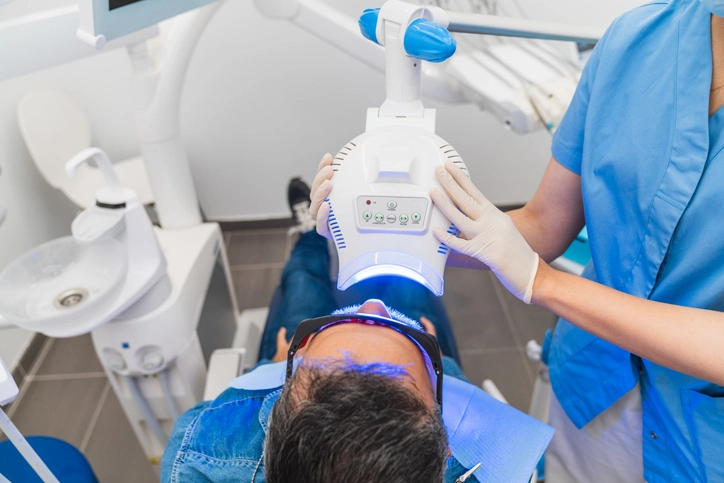
Tooth whitening—also known as tooth bleaching—has become one of the most requested aesthetic dental procedures worldwide. Fueled by growing demand for brighter smiles and supported by decades of research demonstrating its safety and effectiveness, bleaching is now a staple treatment in restorative and cosmetic dentistry. Despite its popularity, however, whitening is often misunderstood. Patients may perceive it as a simple cosmetic enhancement, yet clinicians recognize that it requires careful assessment, planning, material selection, and adherence to established safety regulations.
Table of Contents
ToggleUnderstanding Tooth Discoloration
Tooth discoloration can be broadly categorized into two types: extrinsic and intrinsic.
Extrinsic discoloration
Extrinsic staining occurs on the outer surface of the enamel and is typically caused by:
- Dietary chromogens (tea, coffee, wine, curries)
- Tobacco use
- Poor oral hygiene
- Certain mouthwashes (e.g., chlorhexidine in long-term use)
Extrinsic stains often respond well to scaling, polishing, and bleaching.
Intrinsic discoloration
Intrinsic staining originates within the enamel or dentine due to structural or compositional changes. Causes include:
- Age-related dentine darkening
- Trauma leading to pulp necrosis
- Fluorosis
- Tetracycline staining
- Developmental enamel defects
- Previous root-canal therapy
Intrinsic stains can be more resistant and require whitening techniques such as vital bleaching, non-vital (internal) bleaching, or restorative interventions.
Understanding the type and cause of discoloration is fundamental before beginning treatment. Shade assessment should be carried out using a shade guide or digital photography under standardized lighting.
Regulatory Considerations in Tooth Whitening
A 2012 amendment to European legislation significantly redefined how tooth whitening materials may be used:
Key regulations:
- Tooth whitening is a dental procedure, and must be performed by regulated dental professionals.
- Whitening products containing between 0.1% and 6% hydrogen peroxide or releasing such concentrations (e.g., carbamide peroxide equivalence) must not be used on patients under 18 years old.
- These products may only be used after a clinical examination confirming suitability of the patient and absence of pathology.
- The first application of a whitening cycle must be administered by a dentist, dental hygienist, or therapist under direct supervision.
- Subsequent applications may be completed by the patient at home, provided instructions have been given and professional oversight maintained.
These rules help ensure patient safety and prevent inappropriate use, such as treatment of undiagnosed pathology (e.g., carious lesions, exposed dentine, periodontal disease) or misuse by untrained individuals.
Mechanism of Action of Whitening Agents
Most whitening agents contain either hydrogen peroxide or carbamide peroxide, which releases hydrogen peroxide when decomposed. The active ingredient penetrates the enamel and dentine, producing reactive oxygen species that break down large, pigmented organic molecules into smaller, less pigmented molecules. Importantly:
- The enamel structure remains intact.
- No physical removal of enamel occurs.
- Sensitivity may occur temporarily due to peroxide diffusion affecting the pulp.
Carbamide peroxide releases approximately 1/3 of its concentration as hydrogen peroxide (e.g., 10% carbamide peroxide ≈ 3% hydrogen peroxide).
Vital Tooth Bleaching
Vital bleaching refers to whitening procedures performed on teeth with healthy pulps. Two primary techniques exist: home bleaching and in-office bleaching.
Home Bleaching Technique
This is considered the gold standard due to its safety, predictability, and long-term results. It uses low concentrations of carbamide peroxide (typically 10–15%) delivered via a custom-made soft tray.
Advantages of home bleaching:
- Excellent safety profile
- Less sensitivity compared to in-office bleaching
- Gradual, controllable shade change
- High patient satisfaction
- Stable long-term results
- Cost-effective
Clinical Protocol for Home Bleaching:
Consultation and examination
Assess for caries, cracks, gingival recession, and lifestyle factors. Obtain informed consent and discuss realistic expectations.Take an alginate impression
A well-fitting custom tray is essential for comfort and to prevent gingival irritation.Laboratory fabrication of the bleaching splint
The tray should be thin, with reservoirs only if required and scalloped borders to minimize soft tissue contact.Tray fit appointment and patient instruction
Dispense 10% carbamide peroxide syringes.
Teach the patient how to apply small amounts of gel per tooth.
Provide written instructions.
Recommended wear time
Typically 6–8 hours per day, often overnight.Review appointment
Reassess after 1 week, then weekly thereafter for sensitivity, shade improvement, and compliance.Side effects
Mild sensitivity is common and can be managed with desensitizing toothpaste, fluoride gels, or reduced wear time.
Home bleaching generally requires 2–4 weeks, but more severe cases (e.g., tetracycline staining) may require extended treatment.
In-Office (Power) Bleaching Technique
This method uses higher concentrations of hydrogen peroxide (25–40%) and is performed entirely in the dental surgery.
Clinical indications:
- Patients seeking rapid results
- Uneven bleaching contraindicating home trays
- Patients unable to wear trays
Procedure:
- Protect soft tissues
Apply Orabase® and use a rubber dam to isolate teeth. - Initial cleaning
Use pumice to remove extrinsic stains. - Apply bleaching agent
Follow manufacturer’s instructions strictly. Some systems use a curing light to accelerate peroxide breakdown, though evidence shows similar results with or without activation. - Irrigation
Rinse thoroughly with copious water. - Finishing
Remove rubber dam, polish teeth, and evaluate results. - Post-treatment advice
Avoid staining foods (tea, coffee, red wine) and smoking for at least 1 week.
Advantages
- Immediate results
- Professional control
Disadvantages
- Higher incidence of sensitivity
- Higher expense
- Results may relapse slightly after a few days
- Risk of soft tissue burns if isolation is inadequate
In-office bleaching is often combined with home whitening for optimal, stable outcomes.
Non-Vital Tooth Bleaching
Non-vital bleaching is used on root-treated teeth that have darkened due to breakdown of pulp tissue, haemorrhage products, or over time. Because intrinsic staining is inside the dentine, internal bleaching is often required.
It offers a more conservative alternative to crowns or veneers, preserving tooth structure.
Understanding Discoloration in Root-Filled Teeth
A root-filled tooth may discolor due to:
- Retained necrotic pulp tissue
- Blood breakdown products
- Materials such as amalgam, gutta-percha sealer, or medicaments
- Long-standing endodontic treatment
- Calcification or trauma
As discoloration can recur, patients must be informed of the potential need for retreatment or maintenance.
Research indicates that the initial degree of discoloration and the patient’s age do not significantly affect treatment success.
Walking Bleach Technique (Most Common Method)
This technique uses internal placement of a bleaching agent over several days or weeks.
Clinical Steps:
- Soft tissue protection
Place Orabase® around the gingivae. - Isolation
Use a rubber dam to avoid peroxide leakage. - Open access cavity
Remove gutta-percha 2mm below the gingival margin to prevent external cervical resorption. - Place a barrier
A glass ionomer cement (GI) is placed over the root filling to seal the canal. - Clean the pulp chamber
Remove stained dentine and clean with etchant (followed by alcohol), then dry. - Apply 35% carbamide peroxide
Introduce bleaching material into the pulp chamber. - Seal the tooth
Temporarily seal with cotton wool and GI. - Review after 1–2 weeks
Repeat bleaching if necessary (up to twice). - Final restoration
Permanently restore with resin composite once the desired shade is reached.
Alternative approach: Inside–Outside Technique
In this method:
- A bleaching tray is worn externally, while
- Internal bleaching gel (typically 10% carbamide peroxide) is placed in the pulp chamber,
- Allowing the patient to renew the gel regularly.
This provides simultaneous whitening from both internal and external surfaces.
Safety Considerations in Non-Vital Bleaching
Historically, thermocatalytic bleaching involved applying heat to hydrogen peroxide inside the pulp chamber. This technique is now obsolete due to its association with external cervical resorption, a serious complication.
Modern techniques rely solely on chemical action without heat.
Microabrasion
Microabrasion is a minimally invasive cosmetic procedure used for superficial enamel defects. Unlike bleaching, which chemically alters stains, microabrasion physically removes a small amount of enamel to eliminate discoloration.
Indications:
- Mild fluorosis
- Post-orthodontic demineralization
- Localized enamel hypoplasia
- Traumatic hypoplasia
- Surface-level intrinsic stains
The defect must be confined to the outer enamel layer.
Procedure:
- Isolate teeth using rubber dam.
- Clean and dry affected teeth.
- Apply a slurry of phosphoric acid mixed with pumice or commercially available hydrochloric-acid-based products.
- Rub gently to remove superficial enamel irregularities.
- Rinse thoroughly.
- Review after 1–4 weeks once enamel rehydrates.
Advantages:
- Highly predictable for shallow lesions
- Permanent results
- Conservative
Limitations:
- Not suitable for deep or dentine-level defects
- May require subsequent bleaching
- Overuse can thin enamel
Managing Sensitivity and Patient Expectations
One of the most common concerns in bleaching treatment is tooth sensitivity. This occurs as peroxide penetrates enamel and reaches the dentine–pulp complex. Clinicians should advise:
- Use of desensitizing toothpaste (potassium nitrate)
- Fluoride application
- Reducing wear time of home trays
- Avoiding extreme temperatures in food/drink
- Monitoring progress with regular reviews
Patient expectations should be managed carefully. Whitening results vary based on:
- Nature of discoloration
- Tooth structure
- Duration of staining
- Compliance
Some discolorations, such as tetracycline stains and fluorosis, require extended treatment or combination approaches.
Long-Term Results and Maintenance
Tooth whitening is not a permanent procedure. Over time:
- New stains may accumulate
- Slight shade rebound may occur
- Lifestyle habits influence longevity
Maintenance strategies:
- Avoid frequent consumption of staining foods
- Limit smoking
- Periodic top-up whitening (e.g., one night every 6–12 months)
- Regular professional hygiene appointments
Studies show that shade stability can last several years with proper maintenance.
Contraindications and Precautions
Not all patients are suitable for whitening. Contraindications include:
- Pregnancy and breastfeeding
- Untreated caries or periodontal disease
- Cracked teeth
- Severe sensitivity
- Under 18 years of age (per EU regulations)
- Allergies to peroxide
- Non-compliant patients
Restorations (composite, crowns, veneers) do not bleach, so treatment planning may involve post-whitening replacement of visible restorations.
Conclusion
Tooth whitening is a safe, effective, and minimally invasive procedure when undertaken by qualified dental professionals. Understanding the mechanisms, appropriate clinical protocols, regulatory considerations, and potential complications ensures optimal results and patient satisfaction. Whether performed at home using carbamide peroxide gels, in the clinic using high-concentration hydrogen peroxide, or internally in root-filled teeth, whitening offers a conservative solution to many aesthetic concerns. Complementary techniques such as microabrasion broaden the clinician’s toolkit for managing a wide variety of enamel defects and discolorations.
Effective communication, patient education, and careful case selection remain central to achieving predictable, long-lasting outcomes. With proper guidance, patients can enjoy brighter smiles while maintaining the health and integrity of their natural dentition.
References
- Howell, R.A. (1980). Bleaching discoloured teeth. British Dental Journal, 148, 159–166.
- Nixon, P.J., Gahan, M.J., & Robinson, S. (2007). Bleaching of discoloured teeth: A review of the literature. Dental Update, 34, 412–422.
- Joiner, A. (2006). The bleaching of teeth: A review of the literature. Journal of Dentistry, 34, 412–419.
- Heymann, H.O., Swift, E.J. & Ritter, A.V. (2017). Sturdevant’s Art and Science of Operative Dentistry. 7th ed. Elsevier.
- Kwon, S.R. & Wertz, P.W. (2015). Review of the mechanism of tooth whitening. Journal of Esthetic and Restorative Dentistry, 27(S1), S240–S257.
- European Council Directive 2011/84/EU. (2012). Amending Directive 76/768/EEC concerning cosmetic products. Official Journal of the European Union.
- American Dental Association (ADA). (2021). Tooth Whitening/Bleaching: Treatment Considerations for Dentists and Their Patients. ADA Council on Scientific Affairs.
- Greenwall, L. (2001). Tooth Whitening Techniques. Martin Dunitz: London.
- Haywood, V.B. & Heymann, H.O. (1989). Nightguard vital bleaching. Quintessence International, 20, 173–176.
- Dahl, J.E., Pallesen, U. (2003). Tooth bleaching—a critical review. Dental Materials, 19, 1–10.
- Plotino, G., et al. (2008). Non-vital tooth bleaching: A review of the literature and clinical procedures. Journal of Endodontics, 34, 394–407.
- Attin, T., et al. (2005). Review of the efficacy of vital and non-vital tooth whitening techniques. American Journal of Dentistry, 18, 155–163.
- Croll, T.P. (1990). Enamel microabrasion: The technique. Quintessence International, 21, 25–30.
- Sulieman, M. (2005). An overview of bleaching techniques: 1. History, chemistry, safety, and legal aspects. Dental Update, 32, 398–406.
- Sulieman, M. (2005). An overview of bleaching techniques: 2. Nightguard vital bleaching and power bleaching. Dental Update, 32, 477–484.
- Tredwin, C.J., Naik, S., Lewis, N.J., Scully, C. (2006). Tooth discoloration and bleaching. British Dental Journal, 200, 131–134.