
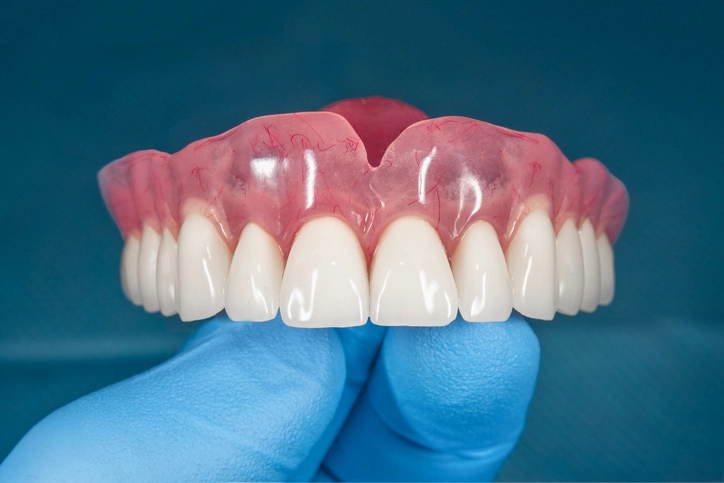
Tooth loss remains a major global health issue, and the transition from partial dentition to complete edentulism can be psychologically and functionally challenging for patients. Immediate complete dentures—defined as dentures inserted immediately after extraction of remaining natural teeth—offer a solution that prevents patients from experiencing a period without teeth. However, this treatment modality is clinically complex and requires meticulous planning, patient cooperation, and an understanding of the biological processes involved.
Table of Contents
ToggleUnderstanding Immediate Complete Dentures
Immediate complete dentures are prostheses constructed in advance and inserted at the same appointment that the patient’s remaining natural teeth are extracted. As a result, the patient leaves the dental office with a full set of dentures rather than experiencing an edentulous healing phase.
The purpose of immediate dentures includes:
- Maintaining esthetics and preserving facial appearance
- Sustaining patient confidence and social comfort
- Preserving vertical dimension of occlusion (OVD)
- Protecting extraction sites by acting as a “bandage”
- Assisting with function during the healing period
- Guiding the patient gradually into the experience of complete dentures
However, these dentures are fabricated before healing takes place, meaning they inherently carry limitations regarding long-term fit and stability. Bone resorption will occur rapidly in the months following extraction, requiring early rebasing, relining, or even replacement.
Alternatives for Patients Who Already Wear a Partial Denture
Transitioning a patient who already uses a removable partial denture (RPD) into complete dentures must be handled sensitively. Such patients have already adapted to removable prostheses, which can make the transition easier. However, many require a planned, gradual progression to avoid psychological and functional distress.
1. Gradual transition with additions to a transitional partial denture
One approach is to slowly add artificial teeth to a transitional partial denture as natural teeth are lost or extracted. This progressive replacement allows the patient to adjust incrementally to:
- Reduced natural tooth support
- Changes in occlusion
- Increasing dependency on the prosthesis
This strategy is especially helpful in elderly patients who may struggle to adapt to sudden major changes.
2. Immediate complete denture replacement
For some patients, transitioning directly to an immediate complete denture may be appropriate. This approach offers key advantages:
- The denture can mimic the shape, position, and esthetics of the natural teeth
- The patient avoids a period without teeth
- The denture can help protect extraction sites
However, these dentures require frequent follow-ups because:
- Soft tissue reshapes rapidly during healing
- Alveolar bone resorption is most pronounced in the first 3 months
- Occlusion may shift
3. Overdentures
An overdenture supported by retained root structures or implants may be preferred if clinically feasible. Overdentures:
- Maintain alveolar bone better than conventional dentures
- Provide improved stability and retention
- Can improve patient satisfaction
However, overdentures require healthy retentive abutments, which may not be available in all cases.
Alternatives for Patients With No Previous Denture Experience
Patients who have never worn removable dentures require additional care and counseling. Their adaptation challenges may be greater due to unfamiliarity with prosthetic appliances.
1. Providing a partial denture first
The best approach for many non-denture wearers is to fabricate a transitional partial denture first. This helps the patient gradually adapt to:
- Wearing a foreign object in the mouth
- Changes in chewing efficiency
- Modified phonetics
- Psychological acceptance of dentures
Once acclimated, the patient can transition to an immediate complete denture.
2. Extracting posterior teeth first
Another strategy involves:
- Extracting most posterior teeth
- Leaving some teeth temporarily to maintain occlusion, OVD, and stability
- After some healing, constructing a better-fitting immediate complete denture
This staged approach reduces the amount of guesswork during denture fabrication and yields more predictable results.
3. Complete extraction followed by delayed denture fabrication
While possible, extracting all remaining teeth first and waiting until full healing occurs (8–12 weeks) before denture construction is generally avoided. This “post-immediate” approach leads to:
- A long period of edentulism
- Social and psychological difficulties
- Rapid bone loss before prosthesis insertion
Thus, immediate dentures are usually preferred unless contraindicated.
Types of Immediate Complete Dentures
Two main categories exist: flanged and open-face dentures.
1. Flanged Dentures
These dentures include an extended flanged border that wraps around the alveolar ridge. Benefits include:
- Improved retention
- Better stability
- Enhanced comfort once healing occurs
- Easier rebasing and relining in the future
Flanged dentures are generally preferred unless deep labial undercuts make them impractical.
2. Open-Face Dentures
Open-face dentures lack a labial flange. Artificial teeth sit over or just into the socket of extracted natural teeth. These are selected when:
- Deep labial undercuts prohibit flange extension
- Surgical reduction is not feasible
However, they usually provide poorer retention and may need frequent adjustments.
Clinical Procedures: Step-by-Step
The clinical stages for immediate complete dentures are similar to those for complete or partial dentures, but they require more planning and precision.
1. Primary Impressions
Primary impressions capture the patient’s current oral anatomy before extractions. Alginate or stock impression trays are typically used. The goal is to obtain:
- Functional sulcus depth
- Ridge morphology
- General soft tissue outlines
These impressions serve as the basis for diagnostic casts.
2. Secondary (Master) Impressions
Master impressions refine the anatomical details. Materials such as silicone or high-quality alginate may be used. Accurate impressions are essential because:
- Denture fit is based entirely on pre-extraction anatomy
- Soft tissue will change dramatically after extractions
- The denture must initially fit well to minimize trauma
3. Recording Occlusion
Recording occlusal relationships is more challenging with natural teeth still present. If posterior teeth remain:
- Hand articulation may suffice
- The patient’s natural occlusion guides artificial tooth arrangement
If insufficient teeth remain:
- Occlusal rims must be constructed
- Facebow or interocclusal records are required
- Jaw relation must be re-established
4. Try-In Stage
The try-in is limited only to areas with missing teeth. This stage allows evaluation of:
- Esthetics
- Setup of anterior teeth (if already present)
- Vertical dimension
- Speech
However, full evaluation is not always possible, as some natural teeth are still present and will only be removed on the day of denture insertion.
5. Extraction of Remaining Teeth
Extractions must be performed carefully to minimize trauma.
Key principles include:
- Gentle handling of tissues
- Atraumatic forceps use
- Avoiding unnecessary removal of bone
- Thorough removal of granulation tissue
The goal is to prevent postoperative inflammation and swelling that may compromise denture fit.
6. Immediate Denture Insertion (“Finish”)
After extractions, the denture is inserted immediately.
Important considerations:
- Do NOT repeatedly remove and reinsert the denture during the first 24 hours
- Only essential adjustments should be made
- The denture protects extraction sites and acts as a pressure dressing
- Overuse of adjustments can distort the intended initial fit
Patients should be instructed to leave the denture in place until the 24-hour review.
Review and Adjustments
At the 24-hour appointment:
- Soft tissue swelling is assessed
- Pressure areas are relieved
- Occlusal contacts are evaluated
- Stability and retention are reassessed
If dentures are unretentive early on, a temporary chairside reline material may be required to increase suction and comfort.
Recall Protocol
Frequent appointments are essential because immediate dentures sit on rapidly changing tissues.
A typical recall schedule includes:
- 1 week: Evaluate healing, comfort, and occlusion
- 1 month: Adjust for early resorption and tissue shrinkage
- 3 months: Begin considering reline or rebase
- 6 months: Long-term evaluation
- Yearly: Routine maintenance and planning for replacement
During the first 3–6 months, bone resorption is fastest. This means:
- Dentures can become loose rapidly
- Food trapping increases
- Ulcerations may occur
- Speech and chewing may worsen
Relines or rebasing become necessary to restore proper fit.
Laboratory Procedures
Laboratory procedures for immediate dentures are similar to conventional complete dentures, with specific differences:
- Plaster teeth from the cast are removed
- The cast is trimmed to approximate expected post-extraction anatomy
- Artificial teeth are set in positions mimicking natural esthetics
- Denture processing must account for soft-tissue collapse
The technician must predict how tissues will appear after extraction—an inherently imprecise process.
Surgical Procedures
Some cases require adjunct surgical procedures to accommodate immediate dentures, such as:
- Alveoloplasty
- Removal of undercuts
- Small soft-tissue corrections
These aim to prepare the ridge to receive the denture optimally.
Common Problems and Management
1. Unretentive Denture
Causes:
- Rapid tissue resorption
- Overextension
- Loss of peripheral seal
Management:
- Temporary reline material (applied repeatedly during first 3 months)
- After tissue stabilization, heat-cured acrylic reline
2. Gross Occlusal Errors
These occur due to:
- Tissue collapse
- Inaccurate predictions during fabrication
- Changes after extraction
Treatment:
- Adjust occlusal surfaces to obtain even bilateral contact
- Replace the denture once initial healing and resorption stabilize
Patient Education and Expectations
Patients must be counseled extensively, including:
- Realistic expectations
- The need for multiple adjustments
- The temporary nature of immediate dentures
- Speech changes
- Diet modifications
- Oral hygiene techniques
Patients should understand that their immediate denture is not their final prosthesis.
Conclusion
Immediate complete dentures play an essential role in modern prosthodontics by allowing patients to avoid the functional and social consequences of tooth loss. While they offer significant psychological and esthetic benefits, their success depends on:
- Comprehensive treatment planning
- Detailed clinical execution
- Clear patient communication
- Diligent postoperative follow-up
This educational article expands greatly on foundational teaching to help students and clinicians understand the complexities of immediate dentures, offering both theoretical and practical insights for effective patient care.
References
- Zarb GA, Hobkirk JA, Eckert SE, Jacob RF. Prosthodontic Treatment for Edentulous Patients: Complete Dentures and Implant-Supported Prostheses. 13th ed. Mosby; 2013.
- McCord JF, Grant AA. Complete Dentures: An Introduction. 2nd ed. British Dental Association; 2000.
- Carr AB, Brown DT. McCracken’s Removable Partial Prosthodontics. 14th ed. Mosby; 2015.
- Winkler S. Essentials of Complete Denture Prosthodontics. 3rd ed. Ishiyaku EuroAmerica; 1994.
- Sheiham A, Steele JG, et al. Textbook of Complete Dentures. Quintessence Publishing; various editions.
- Shillinburg HT, Hobo S, Whitsett LD, Jacobi R, Brackett SE. Fundamentals of Fixed and Removable Prosthodontics. Quintessence Publishing; 1997.
- Carlsson GE. Clinical morbidity and sequelae of treatment with complete dentures. J Prosthet Dent. 1998;79(1):17–23.
- Emami E, de Grandmont P, et al. The impact of edentulism on oral and general health. J Can Dent Assoc. 2013;79:d120.
- Ellis JS, Pelekis ND, Thomason JM. Immediate dentures: treatment planning and clinical procedures. Dent Update. 2007;34(2):100–110.
- Scott BJ, et al. Immediate replacement complete dentures: clinical and laboratory aspects. BDJ. 1986;161:382–386.
- Goodacre CJ, et al. Clinical considerations for immediate complete dentures. J Prosthodont. 2016;25(2):96–102.
- Mendes FA, et al. Patient satisfaction with immediate complete dentures: a systematic review. Gerodontology. 2019;36(3):195–205.
- British Society for Restorative Dentistry. Guidelines for the Provision of Complete Dentures. BSRD; 2020.
- American College of Prosthodontists. ACP Position Statement: Treatment of the Edentulous Patient. ACP; 2016.
- Feine JS, et al. The McGill consensus statement on elderly edentulous patients. Int J Prosthodont. 2002;15:413–414.
- Atwood DA. Reduction of residual ridges: a major oral disease entity. J Prosthet Dent. 1971;26(3):266–279.
- Tallgren A. The continuing reduction of the residual alveolar ridges in complete denture wearers. J Prosthet Dent. 1972;27(2):120–132.
- Misch CE. Dental Implant Prosthetics. Mosby; 2014. (For comparison of bone preservation with overdentures)
- Peterson LJ, et al. Contemporary Oral and Maxillofacial Surgery. Mosby; 2013. (Atraumatic extraction principles)
- Fonseca RJ. Oral and Maxillofacial Surgery. Elsevier; 2018.