
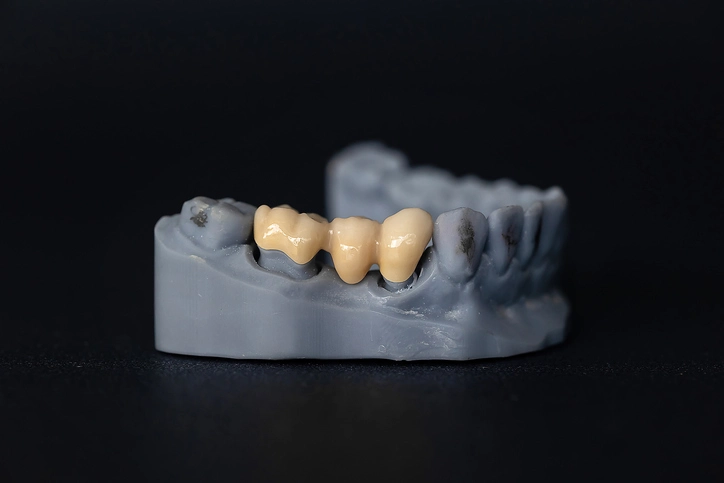
Fixed prosthodontics plays a central role in restorative dentistry, providing functional and aesthetic rehabilitation for patients with missing teeth. Among the various options available, fixed bridges remain one of the most predictable and commonly used treatments for replacing missing teeth when appropriately selected and carefully executed. Successful bridgework, however, relies on thorough assessment, thoughtful design, skilled technical execution, and ongoing maintenance.
Table of Contents
TogglePrinciples of Bridge Design
1. Initial Assessment
The foundation for any successful fixed dental prosthesis is a meticulous assessment of the patient’s dental and periodontal health. This includes an evaluation of:
- Prognosis of adjacent teeth: Understanding the long-term outlook for all teeth near the edentulous space is essential. A tooth with poor periodontal support or questionable endodontic viability may compromise the longevity of the entire bridge. By identifying potential issues early, the clinician reduces the risk of future tooth loss that could destabilize the bridge.
- Abutment teeth suitability: Abutments must be structurally sound and periodontally stable. Radiographs and clinical assessment help determine whether past restorations, recurrent caries, root fillings, or large restorations will affect the ability of a tooth to support a bridge.
- Periodontal condition and mobility: Teeth with active periodontal disease should not be used as abutments until stability is achieved through periodontal therapy.
- Endodontic status: Any abutment with questionable pulp health may require root canal treatment before preparation. Failure to address endodontic issues prior to bridge placement can lead to complications requiring bridge removal.
2. Selection of Retainer and Bridge Type
After evaluating the abutments, the clinician chooses the type of retainers suited for the bridge design. Full-coverage crowns are most commonly used, although partial coverage designs may be considered when tooth structure preservation is a priority and alignment permits.
Bridge configurations include:
- Fixed-fixed bridges where both abutments rigidly support the pontic.
- Fixed-movable bridges incorporating a non-rigid connector to reduce stress transfer.
- Cantilever bridges supported from a single abutment tooth (used selectively in low-load situations such as lateral incisors).
- Fibre-reinforced resin composite bridges for conservative, minimally invasive replacements.
The choice between these depends on load distribution, occlusal factors, periodontal health, esthetic demands, and operator preference.
3. Pontic and Connector Design
Pontics must meet aesthetic, functional, and hygienic requirements. Proper contouring facilitates plaque control and tissue health. Common pontic designs include ridge lap, modified ridge lap (most hygienic), ovate (excellent esthetics), and conical (often used in posterior regions).
Connectors—rigid or non-rigid—must be sized appropriately to withstand occlusal forces without over-contouring or impeding plaque control.
Specific Design Challenges
Clinical situations vary, and certain conditions require modifications to bridge design.
1. Periodontally Involved Abutments
When periodontal disease affects potential abutments, stabilizing the periodontium is a prerequisite. Splinting teeth with fixed-fixed bridges can distribute occlusal forces and improve longevity. In selected cases, fibre-reinforced resin partial dentures may serve as conservative alternatives.
2. Pier Abutments
Pier abutments function as intermediate supports in multi-unit bridges. Because they sit between terminal abutments, they are prone to “rocking” forces: one end of the bridge may seat fully while the other experiences unseating forces. This can cause cement failure or loosening of one retainer.
Solutions include:
- Incorporating a non-rigid connector, such as a key/keyway system, to isolate movement.
- Avoiding pier abutments entirely through treatment plan simplification.
- Using fixed-movable designs that accommodate differential movement.
3. Tilted Abutments
Tilted teeth (often molars drifting into extraction spaces) create alignment issues. The path of insertion becomes compromised, making proper seating and retention difficult.
Management options include:
- Orthodontic uprighting to restore parallelism.
- Two-part bridges allowing independent seating before assembly.
- Telescopic crowns to provide a shared insertion path.
- Precision attachments using screws and tubes to lock components after seating.
4. Replacing Canines
The canine is biomechanically significant due to its long root surface area and role in lateral guidance. Replacing it poses challenges:
- Adjacent teeth may not provide adequate support.
- The canine bears heavy lateral loads.
- If replaced with a bridge, the occlusal scheme should avoid canine guidance and instead incorporate group function to distribute forces.
Practical Stages in Bridge Construction
Bridges are fabricated through several procedural stages that ensure accuracy, function, and long-term clinical success.
1. Diagnostic Mounting
Accurate impressions, a facebow record, and mounting on a semi-adjustable articulator allow for:
- Assessment of existing occlusal relationships.
- Identification of interferences.
- Planning of final occlusion in either ICP or RCP depending on clinical findings.
Mounting in the retruded axis may be critical when reorganizing occlusion or when significant asymmetries exist.
2. Diagnostic Wax-Up
A wax-up provides:
- A three-dimensional preview of the proposed prosthesis.
- A tool to evaluate aesthetic outcomes, including tooth size, shape, and alignment.
- Assessment of occlusal schemes for functional harmony.
- A template for creating matrices used to fabricate temporary restorations.
Diagnostic wax-ups are invaluable for patient communication and informed consent.
3. Tooth Preparation
Preparations follow established principles:
- Path of insertion: Abutments must be parallel or have a shared insertion axis.
- Reduction: Adequate space must be created for restorative materials without over-preparing teeth.
- Margin design: Chamfer or shoulder margins selected based on material.
- Replacement of existing failing restorations may be required to avoid incorporating defective substructures beneath the bridge.
Custom-made paralleling devices or visual aids like mouth mirrors help ensure proper alignment.
4. Temporary Bridge Fabrication
Provisional restorations protect the prepared abutments, maintain function, and guide soft tissues. Using the matrix of the diagnostic wax-up:
- The provisional should reflect the aesthetic and occlusal goals of the final restoration.
- Materials such as Protemp® resin are commonly used.
- Temporary cement (e.g., TempBond®) allows easy removal.
Pontics must be shaped hygienically to maintain healthy soft tissues, often with a modified ridge lap design.
5. Definitive Impression
High-quality impressions are essential for accuracy. Elastomeric materials capture details reliably. When multiple preparations make it difficult to capture all abutments perfectly:
- Transfer coping techniques help reposition individual abutments within the impression.
- Acrylic copings are made on the master casts, placed in the mouth, and then re-seated into the impression to ensure precision.
- Digital scanning (CAD/CAM) is increasingly used to bypass impression errors.
6. Occlusal Registration
Most cases permit mounting in ICP without additional records. However, a record becomes necessary when:
- Large reconstructions cause loss of occlusal reference.
- Preparations remove all occlusal markers.
- Anteroposterior stability in the casts is compromised.
Various occlusal registration materials or techniques can be used, including transfer coping-supported registrations.
7. Metal Try-In
For porcelain-fused-to-metal bridges:
- The metal framework is tried in before porcelain application.
- Proper seating of each retainer is evaluated.
- If one side seats while the other does not, the framework may need to be sectioned and reconnected after adjustment.
This stage allows correction of minor inaccuracies before the addition of porcelain.
8. Trial Cementation
Temporary cementation of the completed bridge allows:
- Verification of comfort and function.
- Evaluation of patient response over days or weeks.
- Identification of any necessary occlusal or fit adjustments outside the mouth.
Patients receive hygiene instructions, including the use of floss threaders or super floss.
9. Permanent Cementation
Once satisfactory fit and function are confirmed:
- The bridge is cemented with a permanent cement such as conventional GIC or resin-modified GIC.
- Excess cement is removed meticulously to prevent periodontal complications.
10. Follow-Up
Routine review ensures:
- Integrity of margins.
- Periodontal health around abutments.
- Functionality and patient comfort.
Bridge Failures: Causes and Management
Patients must be informed of possible complications before treatment begins. Understanding common causes helps in prevention and early intervention.
Causes of Bridge Failure
- Loss of retention: Often due to improper preparation taper, inadequate surface area, or cement failure.
- Mechanical failure: Fracture of cast framework, solder joints, or porcelain chipping.
- Abutment tooth problems: Secondary caries, periodontal deterioration, or pulp necrosis may threaten long-term outcomes.
Management Strategies
Depending on severity:
- Monitoring: Minor issues can be observed over time.
- In situ repairs: Localized defects, such as porcelain fractures, may be repaired with bonding systems (e.g., CoJet™).
- Replacement: If the bridge is structurally compromised or the abutments are failing, replacement becomes necessary.
Replacement of Failed Bridges
Before replacing a bridge, a thorough analysis of the failure is essential. A bridge should not be removed merely because a small defect exists; repair is often preferable.
Minor problems such as:
- Porcelain fractures
- Marginal deficiencies
- Secondary caries around small regions
…can often be resolved conservatively, preserving the existing prosthesis.
Loss of vitality in an abutment tooth is not an automatic indication for bridge removal. Root canal treatment is frequently possible through the retainer.
Removing Old Bridges
Removing an existing bridge can be challenging, particularly when one retainer is still firmly attached.
Several removal strategies include:
- Sharp tapping at the cervical margin with a chisel or slide hammer to break the cement bond.
- Orthodontic band-removing pliers inserted through a small occlusal access hole.
- Sectioning the bridge when atraumatic removal is impossible, destroying the prosthesis but preserving the tooth.
Supporting the bridge during removal ensures that only the targeted retainer is disengaged.
Conclusion
Fixed dental bridges remain a valuable restorative option when designed and executed with precision. Successful outcomes rely on careful case selection, understanding of biomechanical principles, meticulous clinical technique, and patient-centered care. By mastering the diagnostic, technical, and maintenance protocols outlined in this guide, clinicians can ensure long-term function, aesthetics, and patient satisfaction. Continuous follow-up and management of complications further enhance the longevity of fixed prosthodontic work, ultimately contributing to improved oral health outcomes.
References
- Shillingburg, H. T., Hobo, S., Whitsett, L. D., Jacobi, R., & Brackett, S. E.
Fundamentals of Fixed Prosthodontics (4th ed.). Quintessence Publishing; 2012. - Rosenstiel, S. F., Land, M. F., & Fujimoto, J.
Contemporary Fixed Prosthodontics (5th ed.). Mosby Elsevier; 2016. - Goodacre, C. J., Bernal, G., Rungcharassaeng, K., & Kan, J. Y.
“Clinical complications in fixed prosthodontics.” Journal of Prosthetic Dentistry. 2003;90(1):31–41. - Naylor, W. P.
“Nonrigid connectors for fixed prosthodontics.” Journal of Prosthetic Dentistry. 1971;25(1):103–110. - Smith, B. G. N., & Howe, L.
Planning and Making Crowns and Bridges (4th ed.). Taylor & Francis; 2007. - Shillingburg, H. T.
“Rationale for tooth preparation.” Dental Clinics of North America. 1987;31(2):245–258. - Sailer, I., Makarov, N., Thoma, D. S., Zwahlen, M., & Pjetursson, B. E.
“All-ceramic or metal-ceramic tooth-supported fixed dental prostheses?” Journal of Dental Research. 2015;94(8):1339–1347. - Pjetursson, B. E., Tan, K., Lang, N. P., & Brägger, U.
“A systematic review of the survival and complication rates of fixed dental prostheses (FDPs).” Clinical Oral Implants Research. 2004;15(6):625–642. - Chee, W., & Jivraj, S.
“Fixed prosthodontics: complications.” British Dental Journal. 2007;202(2):123–129. - Craig, R. G., & Powers, J. M.
Restorative Dental Materials (12th ed.). Mosby Elsevier; 2006. - Smith, B. G. N., & Earnshaw, R.
Pickard’s Manual of Operative Dentistry (10th ed.). Oxford University Press; 2011. - McLean, J. W.
“Polymer-based materials and provisional restorations.” Dental Update. 1998;25(3):122–127. - Qualtrough, A. J., Burke, F. J., & Wilson, N. H.
“Provisional restorations in fixed prosthodontics.” Dental Update. 1996;23(4):152–159. - Walton, T. R.
“A 10-year longitudinal study of fixed prosthodontics.” Journal of Prosthetic Dentistry. 1999;82(5):493–500. - Kois, J. C.
The Role of Occlusion in Restorative Dentistry. Kois Center Publications; 2004.