
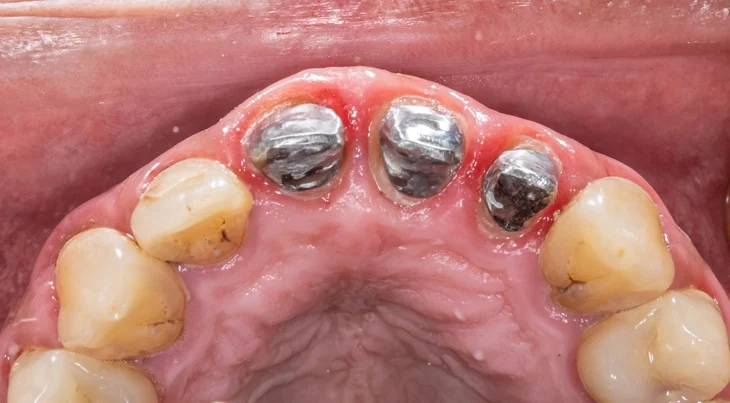
Restoring a tooth that has undergone root canal treatment presents unique clinical challenges. Anterior teeth, in particular, often suffer extensive loss of coronal tooth structure due to caries, trauma, previous restorations, or endodontic access preparations. When insufficient coronal dentin remains to retain a crown, the clinician may need to use a post-and-core system to provide retention and support for the final restoration. Although posts can be valuable tools in restorative dentistry, their use must be carefully considered: posts do not strengthen weakened teeth. In fact, improper use of posts may increase the risk of root fracture or complicate future endodontic retreatment.
Table of Contents
ToggleWhy Posts Are Needed in Endodontically Treated Teeth
An endodontically treated tooth is structurally compromised for several reasons:
- Loss of internal tooth structure through access preparation and canal shaping
- Loss of coronal tooth structure due to caries, trauma, or previous restorations
- Changes in dentin characteristics post-endodontically, including decreased moisture content
- Occlusal stresses, especially in anterior teeth that may be involved in guidance
Posts are primarily used for retention of the core, and the core in turn supports the crown. It is critical to emphasize that:
Posts do NOT reinforce or strengthen teeth.
They simply retain the core. Any forces are transmitted along the post into the root, which can increase the risk of root fracture if design principles are ignored.
A ferrule effect—a 360-degree encirclement of tooth structure by the crown—is essential for long-term success. A ferrule height of at least 1.5–2 mm significantly improves fracture resistance.
Before placing a post, the clinician must ensure that:
- The root canal filling is adequate
- The apical seal is intact (ideally leaving ≥5 mm of gutta-percha)
- No unresolved pathology exists
- The root morphology is suitable for post preparation
If doubts exist regarding endodontic quality, retreatment should be considered before placing a post.
Preliminary Preparation
Preparing a tooth to receive a post involves several important steps. Each step is intended to preserve tooth structure while preparing a stable platform for the final restoration.
1. Coronal Tooth Preparation
The aim is to prepare the crown of the tooth for a full-coverage restoration while retaining as much coronal dentin as possible. Excessive reduction will weaken the remaining structure and reduce ferrule effectiveness.
Weakened or decayed tooth structure is removed. However, the root face should not be flattened during preparation, as this can compromise ferrule and retention.
2. Removal of Coronal Gutta Percha
A heated instrument or Gates–Glidden bur may be used, ensuring the apical seal is not disturbed. Typically:
- Minimum 4–5 mm of gutta percha should remain apically
- Canal length and preparation depth should be verified using silicone stops, periodontal probes, or radiographs
3. Canal Preparation
Canal preparation varies depending on the type of post system being used. The general aim is to:
- Create parallel-sided or appropriately shaped walls
- Avoid excessive dentin removal
- Follow the canal’s natural anatomy to minimize perforation risk
- Maintain the apical seal
As a rule, the post length should be approximately equal to the anticipated crown height, but anatomy and safety limit this in many cases.
Types of Post and Core Systems
There is no single perfect system. Each has advantages and limitations depending on the clinical situation.
1. Prefabricated vs. Custom-Made Posts
Prefabricated Posts
These are mass-produced and ready for immediate use.
Advantages:
- Quick and easy to place
- Economical
- Many designs and materials available
Disadvantages:
- Less adaptable to unusual canal shapes
- Often require more removal of dentin than custom options
- May not provide ideal adaptation
Custom-Made Posts
Usually cast metal.
Advantages:
- Precisely matches canal anatomy
- Excellent adaptation, reducing cement thickness
- Suitable for complex or irregular canals
Disadvantages:
- Requires laboratory stage
- More expensive
- Increased chairside and fabrication time
Custom posts are preferred for extremely elliptical or flared canals where prefabricated posts cannot achieve intimate adaptation.
2. Materials: Metal vs. Non-Metal Posts
Metal Posts
Traditionally used for decades.
Pros:
- High strength
- Established long-term success
- Excellent for high-stress situations
Cons:
- May cause root fracture due to stiffness
- Poor esthetics in anterior region
- Potential corrosion with certain alloys
Metal posts are available as:
- Parallel serrated (e.g., ParaPost®)
- Parallel threaded (e.g., Radix®, Kurer™)
- Tapered threaded (e.g., Dentatus™ screw)—least desirable because they cause high stress concentration
Threaded posts must be cemented passively since active threading into the canal dramatically increases fracture risk.
Non-Metal Posts (Fiber-Reinforced)
These have become highly popular for anterior teeth.
Advantages:
- More flexible, closer to dentin modulus of elasticity
- Lower risk of catastrophic root fracture
- More esthetic—no gray shine-through under all-ceramic crowns
- Failures tend to be adhesive debonding rather than root fracture, allowing easier retreatment
Disadvantages:
- Technique-sensitive bonding
- Long-term fatigue resistance may be lower than metal
- Requires thorough cleaning of canal wall (no residual sealer)
Common systems: LightPost™, ParaPost® FiberWhite, RelyX™ FiberPost.
Post Designs: Parallel-Sided vs. Tapered
Parallel-Sided Posts
Generally preferred due to:
- Superior retention
- Less stress concentration
- More predictable long-term results
Tapered Posts
Match natural canal anatomy but:
- Provide poorer retention
- Are associated with increased stress near the apex
- Useful for small tapered roots such as lateral incisors
Surface Texture: Threaded, Serrated, or Smooth
- Threaded: High retention but increase stress; use only passively cemented
- Smooth: Less retention; relies more on cement
- Serrated: Provide retention while minimizing stress concentration
Indirect Custom-Made Posts
These cast metal posts require precise impressions and laboratory fabrication. They are especially useful when:
- The canal is extremely flared
- A strong core is needed
- Coronal tooth structure is extremely limited
There are two fabrication techniques:
1. Direct Pattern Technique
The clinician fabricates a wax or burn-out resin pattern inside the canal.
Advantages:
- Directly matches canal anatomy
- Reduced risk of impression inaccuracies
Disadvantages:
- Technique sensitive
- Requires careful manipulation in the mouth
2. Indirect Impression Technique
A plastic impression post is placed into the prepared canal, and an impression is taken.
Advantages:
- Less chairside time
- Simpler in some situations
Disadvantages:
- Difficult to maintain a good coronal seal while awaiting the laboratory stage
- Higher risk of impression errors
3. Direct Prefabricated Posts
Prefabricated posts can be placed immediately after canal preparation.
Fibre Posts (Non-Metal)
These require adhesive cementation. Therefore:
- All residual sealer (especially eugenol-based) must be removed
- Alcohol rinse or post-space conditioning may be needed
- Dual-cure or chemical-cure composite is recommended since light may not penetrate deeply
Advantages include:
- Immediate placement after RCT
- Reduced risk of microleakage
- Lower risk of catastrophic root fracture
After bonding the post, the core can be built with composite resin.
Metal Prefabricated Posts
Various designs exist (parallel serrated, parallel threaded, tapered threaded). They are cemented using conventional cements unless the system requires adhesive bonding.
Some systems include a prefabricated core head that integrates with the post, while others require the clinician to build up a core with composite or amalgam.
Practical Considerations and Management of Common Problems
Even with careful planning, complications can arise.
1. Subgingival Tooth Loss
Possible solutions:
- Orthodontic extrusion to bring margins supragingivally
- Crown lengthening surgery
- Cast post and core with an extended post to engage the defect
2. Extensive Tooth Loss or Calcified Canal
Examples: Dentinogenesis imperfecta, severe wear.
Solutions:
- Use adhesive techniques with composite core materials
- Consider porcelain-bonded crowns or crown lengthening
3. Perforation of Root During Post Preparation
Management depends on severity:
- If the post can be removed, seal perforation with MTA using magnification and illumination
- If alignment is incorrect, re-prepare with correct angulation
- Severe cases may require surgical repair
Coronal third perforations generally have a poorer prognosis.
4. Loss of Post
Evaluate cause:
(i) Insufficient length → remake with increased length
(ii) Loose fit or too much canal taper → sandblast post, use adhesive cement (e.g., Panavia™ 21), or remake post
(iii) Perforation-related loosening → radiographic assessment
(iv) Root fracture → extraction
5. Apical Pathology
If root canal treatment is satisfactory, consider periradicular surgery.
If not satisfactory, retreatment and new post placement are advised.
Causes of Failure in Post and Core Crowns
A survey found:
- Many posts fail within the first year
- If a post crown survives 3 years, prognosis for a 10-year survival is favorable
Common failure modes include:
- Caries
- Root fracture
- Mechanical failure of post
- Loss of retention
- Debonding (especially in fibre posts)
The presence of ferrule significantly reduces these risks.
Removal of Old Posts and Cores
Old posts may need removal due to failure, recurrent pathology, or need for retreatment.
Methods:
- Forceps removal (gripping with Spencer–Wells forceps) — limited to loose posts
- Post removers that use root face anchorage — good for cemented posts
- Ultrasonic vibration — often effective but requires aggressive water cooling to avoid heat damage
- Masseran kit or similar systems — create a channel around the post for removal; useful for fractured posts
Caution: Excessive force or inadequate cooling can cause perforation or heat injury.
Clinical Decision-Making: Choosing the Best Post System
The ideal system depends on:
- Amount of remaining tooth structure
- Presence or absence of ferrule
- Esthetic demands
- Root anatomy
- Operator skill
- Type of crown planned (ceramic vs. metal-ceramic)
General Rules of Thumb
- For anterior esthetic cases → fibre posts work very well
- For severely flared canals → custom cast post and core
- For short roots or thin roots → avoid threaded posts especially tapered threaded
- Maintain ≥2 mm ferrule whenever possible
Clinicians should be familiar with multiple systems, as one system alone cannot meet every clinical need.
Key Principles for Success
To maximize success and longevity:
Retention
- Adequate post length
- Parallel walls when possible
- Proper cementation protocol
Resistance and Ferrule
- Maintain maximum coronal dentin
- Aim for ≥2 mm ferrule circumferentially
- Avoid excessive tooth removal during preparation
Material Selection
- Choose fibre posts for esthetic areas and lower fracture risk
- Choose cast posts for flared or irregular canals
Endodontic Quality
- Ensure the root filling is ideal
- Correct any pathology before restoring
- Preserve at least 4–5 mm of gutta percha apically
Conclusion
Anterior post and core crowns remain an important part of restorative dentistry, especially for teeth that have undergone significant structural compromise. While modern adhesive dentistry has reduced the frequency of post placement in some cases, posts are still essential when coronal tooth structure is inadequate to support a crown.
Understanding the biomechanics of root-filled teeth, choosing an appropriate post system, preserving tooth structure, and respecting endodontic principles are all critical to long-term success. By mastering multiple systems and techniques, the clinician is better prepared to manage the wide variety of clinical scenarios encountered in practice.
References
- Shillingburg HT, Hobo S, Whitsett LD, Jacobi R, Brackett SE. Fundamentals of Fixed Prosthodontics. 4th ed. Quintessence Publishing; 2012.
- Torabinejad M, Walton RE. Endodontics: Principles and Practice. 5th ed. Saunders Elsevier; 2014.
- Rosenstiel SF, Land MF, Fujimoto J. Contemporary Fixed Prosthodontics. 5th ed. Mosby; 2016.
- Cohen S, Hargreaves KM. Pathways of the Pulp. 11th ed. Mosby; 2016.
- Heymann HO, Swift EJ, Ritter AV. Sturdevant’s Art and Science of Operative Dentistry. 7th ed. Mosby; 2018.
- Morgano SM, Brackett SE. Foundation restorations in fixed prosthodontics: Current knowledge and future needs. J Prosthet Dent. 1999;82(6):643–657.
- Akkayan B, Gülmez T. Resistance to fracture of teeth restored with different post systems. J Prosthet Dent. 2002;87:431–437.
- Schwartz RS, Robbins JW. Post placement and restoration of endodontically treated teeth: A literature review. J Endod. 2004;30(5):289–301.
- Fokkinga WA, Kreulen CM, Vallittu PK, Creugers NHJ. A structured review of post-and-core systems and failure of restorations. Int J Prosthodont. 2004;17:476–482.
- Bergman B, Lundquist P, Sjögren U, Sundquist G. Restorative and endodontic results after treatment with cast posts and cores. J Prosthet Dent. 1989;61:10–15.
- Ferrari M, Vichi A, Grandini S. Efficacy of different adhesive techniques on bonding to root canal walls. J Endod. 2001;27(5):297–300.
- Monticelli F, Goracci C, Ferrari M. Micromorphology of the fiber post–resin core unit: A scanning electron microscopy evaluation. Dent Mater. 2004;20:176–183.
- Goracci C, Ferrari M. Current perspectives on post systems: A literature review. Aust Dent J. 2011;56(s1):77–83.
- Sorensen JA, Engelman MJ. Ferrule design and fracture resistance of endodontically treated teeth. J Prosthet Dent. 1990;63:529–536.
- Stankiewicz N, Wilson P. The ferrule effect: A literature review. Int Endod J. 2002;35(7):575–581.
- Libman WJ, Nicholls JI. Load fatigue of teeth restored with cast posts and cores and complete crowns. Int J Prosthodont. 1995;8:155–161.
- Assif D, Ferber A. The biomechanical consideration of restoring endodontically treated teeth. J Prosthet Dent. 1982;48:238–244.
- Hoag EP, Dwyer TG. A comparative evaluation of three post-and-core techniques. J Prosthet Dent. 1982;47:177–181.
- Torbjörner A, Karlsson S. Odontological consideration in the restoration of endodontically treated teeth: A review. Endod Dent Traumatol. 1993;9:45–50.
- Zarow M, Devoto W, Panighi M, et al. Methods for post removal: A literature review. Dent Update. 2014;41:384–392.
- Lewis R, Smith B.G.** A survey of failures in post and core crowns. Br Dent J. 1988;165:95. (This is the reference already listed in your textbook extract.)
- Dietschi D, Duc O, Krejci I, Sadan A. Biomechanical considerations for the restoration of endodontically treated teeth: A systematic review. Quintessence Int. 2007;38:733–743.
- Naumann M, Koelpin M, Beuer F, Meyer-Lueckel H. 10-year survival evaluation for glass-fiber–supported post endodontic restoration. Oper Dent. 2012;37(3):257–264.